
More than your website
Your website is no longer the main character
I've been doing SEO for 17 years. For most of that time, the job was simple to explain: make your website the best answer, earn some links, climb the rankings.
Then my clients started asking a new question. "Why does ChatGPT recommend my competitor and not me?"
The honest answer took me a while to accept. When an AI tool searches the web for a recommendation, your homepage may be only one source. Reddit threads, YouTube videos, review sites, articles, local news and directories can also appear. Your website still matters; independent information adds another layer.
So I stopped thinking about "rankings" for these clients and started building what I call the AI signal stack. Here's what's in it, what the data actually says, and what I do for small businesses that don't have a PR team or a content budget the size of a small country.
The study that rearranged my off-page playbook
The moment it clicked for me was an Ahrefs study of 75,000 brands. They measured which factors lined up most with a brand showing up in Google's AI Overviews. Branded web mentions came out on top with a correlation of 0.664. Backlinks, the thing SEOs have chased for two decades, came in at 0.218. (Ahrefs)
The gap between the top and bottom was wild. Brands in the top quarter for web mentions averaged 169 AI Overview mentions. The next quarter down averaged 14.
In December 2025, Ahrefs ran it again across ChatGPT, AI Mode, and AI Overviews. This time YouTube mentions beat everything, at roughly 0.737, and it held up regardless of which AI platform they looked at. (Ahrefs)
One honest caveat I give every client: this is correlation, not proof. Ahrefs says so in its own write-up. Big brands get more mentions and more AI visibility partly because they're big. But every study I've read points the same direction, and the cost of building these signals is low compared to the cost of being invisible. That's a bet I'm comfortable making.
The AI signal stack at a glance
Five places I look for useful, accurate information about a business—not a guaranteed ranking formula.
- 01
- 02
- 03Third-party mentions
Independent perspectives
Credible local media, partners, podcasts and industry coverage.
- 04Reviews & directories
Local business information
Accurate listings and genuine reviews, following platform rules.
- 05
Signal 1: Reddit, the word of mouth layer

I wrote a whole piece on this one, so here's the short version. Reddit can surface public experiences and practical comparisons, especially in “best X for Y” discussions. Replies and votes help people understand a conversation; they are not a verified AI ranking formula.
Bluefish data reported by Adweek found YouTube appeared as a cited source in 16% of tracked LLM answers over six months, versus 10% for Reddit. That is one sample, not a universal ranking. Reddit remains worth investigating alongside video, reviews and other sources.
What I do: show up as a real person in local and niche subreddits, answer questions without pitching, and let customers mention the business on their own. The full playbook is in the companion article.
Signal 2: YouTube, the one most small businesses are sleeping on

YouTube is a channel I would seriously consider for a small business. BrightEdge reported that 29.5% of the Google AI Overviews it tracked cited YouTube. This is a share of tracked answers, not a share of all citations or a permanent rate.
OtterlyAI’s 2026 study found that 40.83% of AI-cited YouTube videos in its sample had fewer than 1,000 views. You do not need a huge audience to make useful content. That does not guarantee a new video will be cited.
Search-enabled AI tools can use video descriptions and transcripts, and capabilities vary by platform. Clear spoken answers, accurate captions and useful descriptions make the content easier to understand; do not assume every model processes video in the same way.
An honest note on YouTube comments. People ask me whether dropping comments on popular videos helps. I haven't seen solid evidence that comments get cited the way transcripts and descriptions do. The bigger win is being mentioned in other creators' videos, because Ahrefs measured YouTube mentions as the strongest correlation with AI visibility. So I'd rather spend an hour getting a client featured on a local creator's channel than an hour leaving comments. Comments are fine for community building. Just don't expect them to move AI answers on their own.
- Make complete answers, not just Shorts. OtterlyAI found roughly 94% of YouTube citations in its sample went to long-form videos. Let the customer’s question determine the length; there is no guaranteed sweet spot.
- Title each video as the question a customer would ask. "How much does AC repair cost in San Diego?" beats "Episode 12."
- Say the business name, city, and service out loud in the first minute, since that ends up in the transcript.
- Review the captions after upload and correct misspelled names or inaccurate terms before making the video public.
- Add chapters and a description that summarizes the answer in plain text.
Signal 3: Third-party mentions, aka other people saying your name
Independent reviews and articles can add context that your own website cannot provide alone. Think of the difference between a friend’s restaurant recommendation and the restaurant’s own billboard—not a universal rule about what every AI trusts.
Reviews, listicles, forums, case studies and comparison pages can provide independent perspectives. Start with sources that actually appear for your customer questions rather than assuming a percentage applies to every tool.
Ahrefs studied linked and unlinked branded mentions. Both can be useful to investigate, but a correlation is not evidence that any individual mention will change an answer.
Where I hunt for mentions for small businesses:
- “Best of” articles. Find credible guides to “best [service] in [city]” and pitch the writer a factual, useful reason to consider your business. Coverage and AI citations are never guaranteed.
- Local media. Neighborhood blogs, the local business journal, community newsletters. Small outlets, real trust.
- Podcasts. Local business and industry podcasts often publish transcripts and show notes, which gives AI more text with your name in it.
- Partners and suppliers. The brands you stock, the vendors you use, the chamber of commerce. Ask for a mention on their "where to buy" or member pages.
- Trade press. Check which industry publications are actually cited for your niche and focus on credible coverage there.
Signal 4: Reviews and directories, the local trust layer
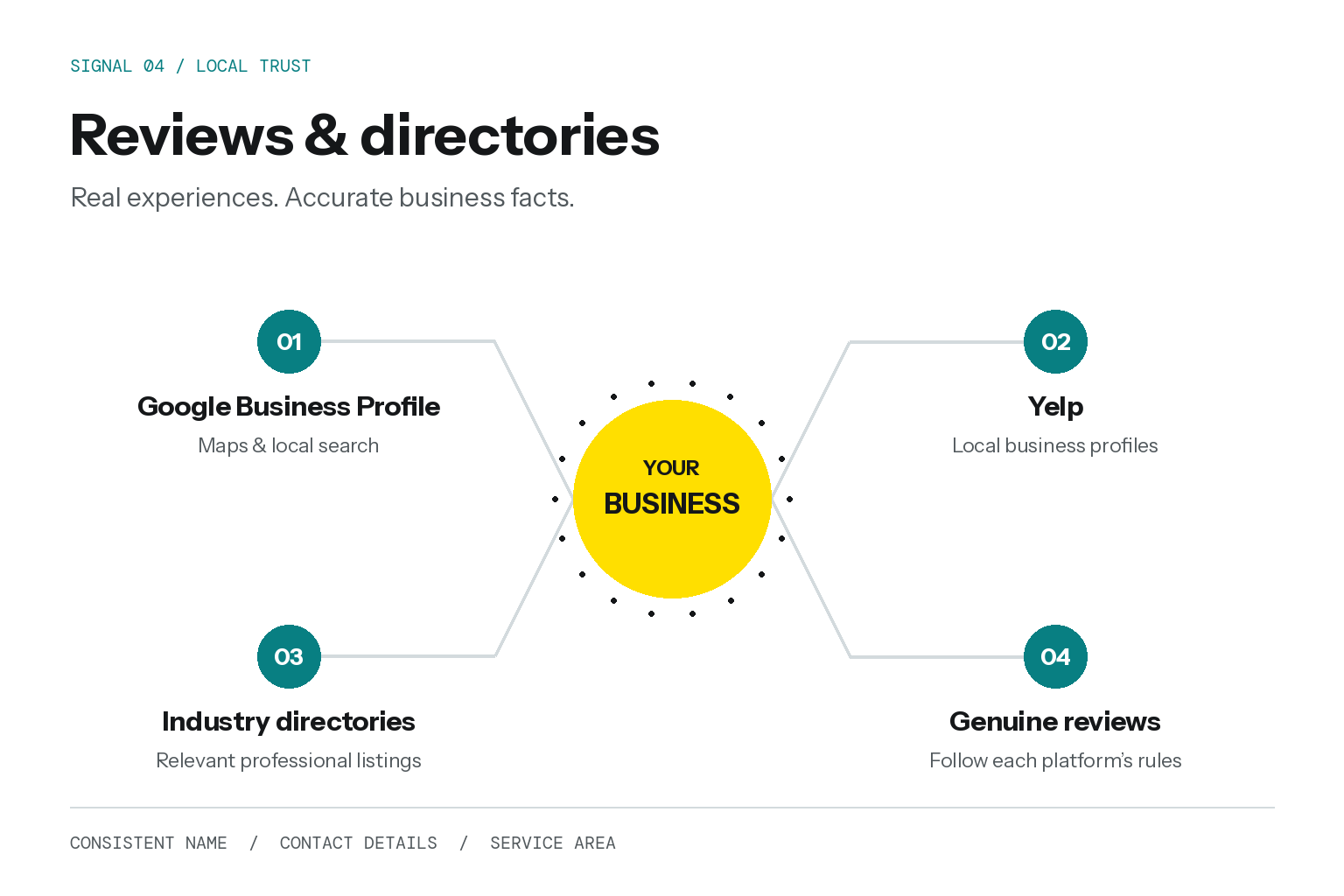
For local businesses, accurate listings and genuine customer reviews are a practical foundation. Look beyond Google, and check which sources each AI tool actually shows.
Foundation, working with AirOps, reported that Yelp received 3.4 times as many citations as the next closest local-discovery platform across more than 28 million tracked AI responses to local-business queries. Separately, Axios reported a Yelp–OpenAI data-licensing partnership in July 2026. Neither finding guarantees that a particular business profile appears in ChatGPT.
Google Business Profile remains essential for Google Maps and local search. Keep Facebook and relevant directories accurate too, then compare the sources each AI tool actually shows.
- Claim and fully complete Yelp, Google Business Profile, Facebook, Bing Places, and Apple Business Connect.
- Add the industry directories that matter, like Houzz for contractors or Healthgrades for practices.
- Follow each platform’s review rules. Google allows requests for genuine reviews without incentives; Yelp tells businesses not to ask for reviews. Never pressure customers or filter requests to only happy customers.
- Reply to reviews thoughtfully without revealing private customer details. Explain your work in general terms; do not turn a response into keyword stuffing.
Signal 5: Entity consistency, making sure the internet agrees on who you are
This one is boring. It also quietly breaks everything else if you skip it.
If Yelp says “Joe’s Heating,” Google says “Joe’s HVAC Services,” and your website and Facebook disagree about the service area, customers and search tools may find conflicting facts. Consistency reduces confusion; it is not a proven formula for more AI recommendations.
No one will ever compliment you on this. That's fine. Plumbing isn't glamorous either, but you notice when it's missing.
- Write one master description of the business: name, services, service area, what makes it different. Two or three sentences.
- Keep the core facts consistent across profiles, directories and bios; adapt the wording to each platform.
- Keep the business name, address, and phone identical everywhere.
- Add basic structured data to the website so the facts are easy for machines to read.
My 90-day playbook for small business clients
Here's the order I work in. It starts with the cheap, boring stuff and builds toward the signals that take longer.
Days 1 to 30: Fix the foundation
- Ask ChatGPT, Claude, Perplexity, and Google AI Mode the 10 to 20 questions a customer would ask. Write down who gets recommended and which sources get cited.
- Write the master business description and push it to every profile.
- Claim and complete Yelp, Google Business Profile, Facebook, Bing Places, Apple Business Connect, and one or two industry directories.
- Set up a steady, honest review process where permitted. Do not solicit Yelp reviews or offer incentives.
Days 31 to 60: Start making noise
- Record two or three long-form YouTube videos answering the most common customer questions.
- Pitch the writers of the top "best [service] in [city]" articles.
- Begin genuine participation in the relevant local and niche subreddits.
- Ask partners, suppliers, and local organizations for mentions on their sites.
Days 61 to 90: Earn the bigger mentions
- Pitch local podcasts and local creators on YouTube.
- Reach out to local media and the trade publications that AI cites most in the client's industry.
- Re-run the same AI questions from day one and compare.
What not to do
Every new channel attracts shortcuts. These are the ones I steer clients away from.
- Don't fake reviews or Reddit posts. Platforms catch it, communities call it out, and a thread exposing your fake accounts is a mention you really don't want AI reading.
- Don't buy listicle placements from sketchy "best of" sites. Pay-to-play lists on low-quality sites are easy to spot, and they can make you look worse.
- Do not assume Shorts alone are a complete video strategy. Test the formats your customers need and measure which sources actually appear.
- Don't spam comments with links. It's not a signal, it's a nuisance.
- Don't abandon your website. AI still checks it to confirm facts. It's just not the only thing it reads anymore.
How I measure it
AI answers shift every time you ask, so I don't trust one screenshot. Citations rotate from one run to the next even for the same question. (AirOps)
Here's my simple tracking setup:
- A fixed prompt list. The same 10 to 20 customer questions, asked monthly across ChatGPT, Claude, Perplexity, Gemini, and Google AI Mode.
- Two separate counts. Mentions (the AI names the business) and citations (the AI links to a source about the business). They move differently, so I track them apart.
- Source tracking. Which Reddit threads, videos, review sites, and articles keep getting cited. That tells me where to double down.
- A tool for scale. For clients with budget, Ahrefs Brand Radar and similar trackers automate this. For everyone else, a spreadsheet works fine.
- Real business results. Calls, form fills, and "how did you hear about us?" answers. If customers start saying "ChatGPT," that's the scoreboard that matters.
Frequently asked questions
How do I get my business recommended by ChatGPT?
Build accurate business profiles, helpful website answers and genuine independent coverage through relevant communities, video, reviews and articles. Track what ChatGPT actually shows. No one can guarantee a recommendation.
Are backlinks still worth it?
Yes. Backlinks still matter for search. Ahrefs found branded mentions correlated more strongly with AI Overview visibility in its 75,000-brand study, but correlation is not a universal ranking rule.
Is YouTube more important than Reddit now?
It depends on the tool, question and sample. Both appear in citation research. I compare actual answers for a business before choosing where to invest.
Do YouTube comments help with AI visibility?
I haven't seen good evidence that they do on their own. Video transcripts, descriptions, and being mentioned in other creators' videos matter much more.
How long does this take?
I use a 90-day work plan to build the foundation and begin outreach, not as a promise of results. Mentions and video take sustained effort, and some businesses may see no measurable AI visibility improvement.
Can a small business really compete with big brands here?
A small business can create useful local answers and credible profiles without a large budget. OtterlyAI found many cited videos had fewer than 1,000 views, but that does not predict results for any one business.
Want to know what AI says about your business?
Let’s look at who gets recommended, which sources appear and where your business information is missing. Chris brings 20 years in marketing and experience running one of the world’s largest websites, with 1.2 billion pages.
Start with a free audit conversation. No jargon, no 40-slide deck—just a practical plan for getting found and turning attention into inquiries.
Go over my free audit with ChrisSources
- Ahrefs: AI Overview brand correlations—75,000 brands
- Ahrefs: Brand visibility correlations across ChatGPT, AI Mode and AI Overviews
- BrightEdge: YouTube presence in AI search
- Adweek: Bluefish analysis of YouTube and Reddit citations
- OtterlyAI: YouTube AI citation study, 2026
- Foundation / AirOps: Yelp and AI local discovery
- Axios: Yelp and OpenAI data partnership
- OpenAI: Reddit partnership
- Google: Tips to get more reviews
- Yelp: Why businesses should not ask for reviews
Studies describe their own samples and dates. Citation frequency and correlation do not establish private ranking rules or guaranteed recommendations. Each platform’s answers can vary by question, location and date.